The Incredible Power of Visual Learning
Here is an excerpt from an article that just appeared in Scientific American Mind. It's from the April/May 2006 edition:
"Humans See, Human Do - Brain Cells That Mirror Actions We See Are Key to Learning..."
"[Mirror] neurons are scattered throughout key parts of our brain -- the premotor cortext and centers for language, empathy, and pain -- and fire not only as we perform a certain action but also when we watch someone else perform that action. These neurons have been studied in the past for their roles in movement and other functions. Now, however, researchers are examining them intensely for what seems to be an additional function -- the way they fire in response to something observed. The discovery of this mechanism, made about a decade ago, suggests that everything we watch someone else do, we do as well -- in our minds. At its most basic, this finding means we mentally rehearse or imitate every action we witness, whether it is a somersault or a subtle smile. It explains how we learn to smile, talk, walk, dance, or play tennis."
Scientific American Mind
April/May 2006
P. 23-24
Saturday, September 15, 2007


Shaft Flex Point: Myth or Legend?
Golf Shaft Flex Point: Myth or Legend?
By: Mike Tait
President, and Club Designer of SMT Golf
You hear players giving advice all the time on getting the correct flex point on the shaft you are using. Retail store clerks tout the magic of this phenomenon when they have you in front of the display of brightly painted shafts on the wall. Truth be told, while not a myth, it has turned into one of the biggest mysteries in the sport.
Players have been conditioned to believe that the difference between a high flex point and a low flex point can be virtually from just below the grip to right above the ferrule on the clubhead. But the truth is that the distance between High and Low Flex Point is basically 2.5 inches in the middle of the shaft. Arguably hardly worth talking about, but I, of course, find myself unable to stop here.
Flex point is most talked about when discussing a shaft choice to make the golf ball trajectory change, The higher the "flex point", the lower the peak trajectory of the shot for that particular club. The lower the "flex point" the higher the peak trajectory will be for the club used. In reality, I have found that "flex point" is used more like a crutch in the clubfitting process and certainly when diagnosing playing problems. And is all too often used to help "ring the register" because it is something we have all heard of but really know almost nothing about.
Players and clubmakers are quick to want to suggest reshafting to a shaft with a different flex point, but in reality we might want to be looking at it a bit differently, perhaps a bit more logically.
We have all come to the golf course or driving range with a swing speed. I don't care what yours is, and you don't care what mine is. Each club in our bags really has a maximum speed that we can swing it. After a big bucket of balls, logic might tell us that we are probably swinging it a bit slower than earlier in the bucket due to muscle fatigue. We are not Tour Professionals and only have so many full swings in us before we lose a bit of the edge. As weekend players, we tend to reach that level sooner than your conditioned golf professional will.
That being said, and if you agree with that statement, you can agree that shaft WEIGHT has much more to do with trajectory and certainly has taken much more than its share of the blame, and of course, the glory, for the elusive "flex point" issue. What I mean is, if we all swing at a max speed, and we put a heavier product in out hands, we are certainly going to swing it a bit slower. If we swing it a bit slower, the ball flight laws tell us that the ball will not spin as much and therefore will not rise as high. Of course, if we go to a lighter shaft, we will swing the club just a bit faster, in effect adding spin to the ball causing it to rise quicker and higher. Either way, the blame or kudos are often given to "flex point". The example is really quite simple. Can you throw a bowling ball higher or a baseball higher? Remember, you came to me with a swing speed, and that did not really change within the two throws required to complete this simple test.
Don't get me wrong, flex point is not like the Loch Ness Monster, it can actually be found and identified. But just like the Loch Ness Monster, because we can find it, doesn't mean that we always know what to do with it, or if it has any real value once we have our hands on it.
I contend that shaft WEIGHT or overall weight of the club (not swingweight) has much more to do with the overall trajectory of our shots than "flex point" will ever have.
The answer, as with virtually all of my teachings and theories is really quite simple and basic. If you want to hit the ball higher, you can and should look to a lighter shaft or lighter overall product. If you want to hit the ball lower, you should look to a heavier shaft or heavier product.
Certainly loft and length are an issue, but for the sake of this topic, we will stick with weight and how it gets confused by virtually everyone for "flex point".
In the SMT - RLM shaft lineup, the sales leader Miridio is the lightest weight and produces arguably the highest trajectory of the three shafts available, while the Argent being slightly heavier tends to keep the ball down out of the wind a bit more than the others. The Basalt, is the perfect combination of the two. Experiment to see what works best for you, but take an assessment of your own game by asking yourself how you tend to hit the ball overall..... higher or lower, and how would changing that ball flight alter your game? But don't get bogged down in the marketing hype when looking to buy a new shaft. Close the catalogs and the golf magazines and use some common sense. If the shaft is heavier, the ball will fly lower in the same clubhead and if the shaft is lighter weight it will generally make the ball fly higher. It really is as simple as that.
By: Mike Tait
President, and Club Designer of SMT Golf
You hear players giving advice all the time on getting the correct flex point on the shaft you are using. Retail store clerks tout the magic of this phenomenon when they have you in front of the display of brightly painted shafts on the wall. Truth be told, while not a myth, it has turned into one of the biggest mysteries in the sport.
Players have been conditioned to believe that the difference between a high flex point and a low flex point can be virtually from just below the grip to right above the ferrule on the clubhead. But the truth is that the distance between High and Low Flex Point is basically 2.5 inches in the middle of the shaft. Arguably hardly worth talking about, but I, of course, find myself unable to stop here.
Flex point is most talked about when discussing a shaft choice to make the golf ball trajectory change, The higher the "flex point", the lower the peak trajectory of the shot for that particular club. The lower the "flex point" the higher the peak trajectory will be for the club used. In reality, I have found that "flex point" is used more like a crutch in the clubfitting process and certainly when diagnosing playing problems. And is all too often used to help "ring the register" because it is something we have all heard of but really know almost nothing about.
Players and clubmakers are quick to want to suggest reshafting to a shaft with a different flex point, but in reality we might want to be looking at it a bit differently, perhaps a bit more logically.
We have all come to the golf course or driving range with a swing speed. I don't care what yours is, and you don't care what mine is. Each club in our bags really has a maximum speed that we can swing it. After a big bucket of balls, logic might tell us that we are probably swinging it a bit slower than earlier in the bucket due to muscle fatigue. We are not Tour Professionals and only have so many full swings in us before we lose a bit of the edge. As weekend players, we tend to reach that level sooner than your conditioned golf professional will.
That being said, and if you agree with that statement, you can agree that shaft WEIGHT has much more to do with trajectory and certainly has taken much more than its share of the blame, and of course, the glory, for the elusive "flex point" issue. What I mean is, if we all swing at a max speed, and we put a heavier product in out hands, we are certainly going to swing it a bit slower. If we swing it a bit slower, the ball flight laws tell us that the ball will not spin as much and therefore will not rise as high. Of course, if we go to a lighter shaft, we will swing the club just a bit faster, in effect adding spin to the ball causing it to rise quicker and higher. Either way, the blame or kudos are often given to "flex point". The example is really quite simple. Can you throw a bowling ball higher or a baseball higher? Remember, you came to me with a swing speed, and that did not really change within the two throws required to complete this simple test.
Don't get me wrong, flex point is not like the Loch Ness Monster, it can actually be found and identified. But just like the Loch Ness Monster, because we can find it, doesn't mean that we always know what to do with it, or if it has any real value once we have our hands on it.
I contend that shaft WEIGHT or overall weight of the club (not swingweight) has much more to do with the overall trajectory of our shots than "flex point" will ever have.
The answer, as with virtually all of my teachings and theories is really quite simple and basic. If you want to hit the ball higher, you can and should look to a lighter shaft or lighter overall product. If you want to hit the ball lower, you should look to a heavier shaft or heavier product.
Certainly loft and length are an issue, but for the sake of this topic, we will stick with weight and how it gets confused by virtually everyone for "flex point".
In the SMT - RLM shaft lineup, the sales leader Miridio is the lightest weight and produces arguably the highest trajectory of the three shafts available, while the Argent being slightly heavier tends to keep the ball down out of the wind a bit more than the others. The Basalt, is the perfect combination of the two. Experiment to see what works best for you, but take an assessment of your own game by asking yourself how you tend to hit the ball overall..... higher or lower, and how would changing that ball flight alter your game? But don't get bogged down in the marketing hype when looking to buy a new shaft. Close the catalogs and the golf magazines and use some common sense. If the shaft is heavier, the ball will fly lower in the same clubhead and if the shaft is lighter weight it will generally make the ball fly higher. It really is as simple as that.
Tuesday, September 11, 2007
Has Golf Become a Frustrating Form of Recreation?
In an earlier article I spoke about the decline of the game and laid part of the blame at the feet of not only the governing bodies of golf but also at the feet of those who are developing and designing golf courses.
It is my opinion though that the majority of blame is directly on the shoulders of the PGA. It is my opinion that those who are responsible for the education and teaching of how to play the game have and are failing miserably. The fact of the matter is that though equipment has seen improvement beyond what many thought possible, the handicaps and skill set of golf players throughout the industry has improved ZERO. When it comes to true handicaps, way too many golfers do not have nor can they play to a 10 handicap or less.
In the beginning Medicus Golf was a training aid company with a purpose of helping golfers. We have now expanded our mission to include not only that of aids but to also assist golfers to improve through golf swing education. But this is not why I mention this. I mention this due to the fact that on a daily basis we are in contact with hundreds of golfers calling to purchase swing aids. In most cases these golfers are presently working with someone who is providing lessons for them. This does not make logical sense to me though I must admit that for our business this is a good thing. But, why would anyone who is working with a golf teacher/educator ever have a need for a training aid. It is one thing when an instructor would request the student to place an order to assist them with their swing faults but this is seldom the case. The students are the ones who are still searching on their own. The other amazing thing to me is that most students see and view their instructor as the best thing since sliced bread. This makes no sense.
It is my opinion that the students are not improving due to those who are providing the information are teaching a lot of experience and feel, and though in general the information may be good, it is far from being complete. With the information being incomplete the student never gets the correct mechanics for them and then the natural progression into their OWN feel, not the teachers, is never accomplished.
As Homer Kelley stated, “There are a lot of very smart people playing some very poor golf.” Why is this the case? They lack the information to succeed! Period! No ifs, ands or buts.
So until golfers, especially new to the game or those who have left frustrated with the game, can get the correct information, so the game is not a frustrating form of recreation, the game of golf will suffer. This added to the equipment issues, course design and other issues mentioned in the previous article, makes a turnaround for growth quite bleak but…..the fix is NOT that hard to implement, sell or get across to the public. All we need is to implement change with correct educational information of how to play the game and to make the game fun for all.
Randy Sparks
It is my opinion though that the majority of blame is directly on the shoulders of the PGA. It is my opinion that those who are responsible for the education and teaching of how to play the game have and are failing miserably. The fact of the matter is that though equipment has seen improvement beyond what many thought possible, the handicaps and skill set of golf players throughout the industry has improved ZERO. When it comes to true handicaps, way too many golfers do not have nor can they play to a 10 handicap or less.
In the beginning Medicus Golf was a training aid company with a purpose of helping golfers. We have now expanded our mission to include not only that of aids but to also assist golfers to improve through golf swing education. But this is not why I mention this. I mention this due to the fact that on a daily basis we are in contact with hundreds of golfers calling to purchase swing aids. In most cases these golfers are presently working with someone who is providing lessons for them. This does not make logical sense to me though I must admit that for our business this is a good thing. But, why would anyone who is working with a golf teacher/educator ever have a need for a training aid. It is one thing when an instructor would request the student to place an order to assist them with their swing faults but this is seldom the case. The students are the ones who are still searching on their own. The other amazing thing to me is that most students see and view their instructor as the best thing since sliced bread. This makes no sense.
It is my opinion that the students are not improving due to those who are providing the information are teaching a lot of experience and feel, and though in general the information may be good, it is far from being complete. With the information being incomplete the student never gets the correct mechanics for them and then the natural progression into their OWN feel, not the teachers, is never accomplished.
As Homer Kelley stated, “There are a lot of very smart people playing some very poor golf.” Why is this the case? They lack the information to succeed! Period! No ifs, ands or buts.
So until golfers, especially new to the game or those who have left frustrated with the game, can get the correct information, so the game is not a frustrating form of recreation, the game of golf will suffer. This added to the equipment issues, course design and other issues mentioned in the previous article, makes a turnaround for growth quite bleak but…..the fix is NOT that hard to implement, sell or get across to the public. All we need is to implement change with correct educational information of how to play the game and to make the game fun for all.
Randy Sparks
Monday, September 3, 2007


Saturday, September 1, 2007
Putt Like The Pros
Golf tip: Putt like the pros
Look at the world's best putters and they all have at least one thing in common: Once they pick the line, they focus on the pace of the putt. They do not "fall in love" with the line. This only leads to putts that are short.
The best putters use different types of strokes and grips. Some of them use a straight back/straight through type of stroke while others use the arc approach.
Let's examine these types of strokes.
1. With the arc approach the club moves back, up, and in during the backstroke, which means it has to move down, out, and forward in the downstroke. Because the player is using this arc approach, ball location is critical. Too far forward and you will pull the putt and too far back and you will push it.
2. The straight back and through method produces a putter face that essentially looks at the ball during the stroke. Since the putter is now moving on a vertical plane there is no inward motion, which means there is no outward motion. Ball location isn't nearly as critical since the face isn't opening or closing.
Players also have a variety of ways they stand at the ball when putting: Some use the so-called square stance, while others use an open one.
Then there is putter and grip styles.
Ken Green uses a putter about 30 inches long while other Bruce Leitzke uses a long putter anchored at the top of his chest. Grip styles range from overlap to reverse overlap, the claw, the saw, cross handed, you name it!
The bottom line is use whatever you want style you want, as long as you're making putts.
Don't be worried about what your playing partners may think or say, you're the one making the putts, not them.
Bernhard Langer has overcome the yips at several times in his career. Do you think he cares what other players think about his putting style?
Whatever you decide to do, stick to it and work on it. Good putting can make up a lot of strokes and bring that handicap down.
Chuck Evans is one of only 31 teachers worldwide designated to hold a "Doctorate in Golf Stroke Engineering." He is executive director of instruction for the Medicus Golf Institute and has served as director of schools for the PGA Tour Golf Academy , and the director of instruction for The Golfing Machine and the United States Golf Institute.
Look at the world's best putters and they all have at least one thing in common: Once they pick the line, they focus on the pace of the putt. They do not "fall in love" with the line. This only leads to putts that are short.
The best putters use different types of strokes and grips. Some of them use a straight back/straight through type of stroke while others use the arc approach.
Let's examine these types of strokes.
1. With the arc approach the club moves back, up, and in during the backstroke, which means it has to move down, out, and forward in the downstroke. Because the player is using this arc approach, ball location is critical. Too far forward and you will pull the putt and too far back and you will push it.
2. The straight back and through method produces a putter face that essentially looks at the ball during the stroke. Since the putter is now moving on a vertical plane there is no inward motion, which means there is no outward motion. Ball location isn't nearly as critical since the face isn't opening or closing.
Players also have a variety of ways they stand at the ball when putting: Some use the so-called square stance, while others use an open one.
Then there is putter and grip styles.
Ken Green uses a putter about 30 inches long while other Bruce Leitzke uses a long putter anchored at the top of his chest. Grip styles range from overlap to reverse overlap, the claw, the saw, cross handed, you name it!
The bottom line is use whatever you want style you want, as long as you're making putts.
Don't be worried about what your playing partners may think or say, you're the one making the putts, not them.
Bernhard Langer has overcome the yips at several times in his career. Do you think he cares what other players think about his putting style?
Whatever you decide to do, stick to it and work on it. Good putting can make up a lot of strokes and bring that handicap down.
Chuck Evans is one of only 31 teachers worldwide designated to hold a "Doctorate in Golf Stroke Engineering." He is executive director of instruction for the Medicus Golf Institute and has served as director of schools for the PGA Tour Golf Academy , and the director of instruction for The Golfing Machine and the United States Golf Institute.
Tuesday, August 28, 2007
Mind Practice
Researchers doing studies on Olympic athletes have found that the brain cannot differentiate between what is really happening and what is imagined.
Tests done on these world-class athletes showed that the brainwaves for the athletes were the same whether they were actually running or simply imagining they were running.
What this means to golfers is if you can imagine yourself making that move your pro taught you, its the same as you pounding bucket after bucket of balls at the range. The advantage you have with visualisation is that you can corroborate easily the changes by visualising and then practicing in front of a mirror. Try it and see how you fare.
If you can conceive the image of you swinging in a proper fashion then you can achieve it.
Tests done on these world-class athletes showed that the brainwaves for the athletes were the same whether they were actually running or simply imagining they were running.
What this means to golfers is if you can imagine yourself making that move your pro taught you, its the same as you pounding bucket after bucket of balls at the range. The advantage you have with visualisation is that you can corroborate easily the changes by visualising and then practicing in front of a mirror. Try it and see how you fare.
If you can conceive the image of you swinging in a proper fashion then you can achieve it.
The Back Stroke
By: Chuck Evans
Once address is completed we can start the backstroke which involves two separate movements. These movements are controlled from the waist up. The lower body should be moved by the upper body if the player is flexible enough, if not, then allow it to move freely in both directions.
The hands and arms … the vertical plane
The shoulders … the horizontal or inclined plane
At this point we would like to remind you that Address and Impact are NOT THE SAME! The only thing that has not changed is the ball position.
You may use any backstroke procedure you choose and there are basically three to choose from.
A one piece takeaway…Jack Nicklaus and Tiger Woods
A two piece takeaway…Ernie Els, David Duval, Karrie Webb, Anika Sorenstam
A three piece takeaway…Raymond Floyd, Nancy Lopez
Choose anyone you wish that feels comfortable and natural. What initiates the backstroke? Ask ten different instructors and you will get ten different answers. Some player's feel it starts with turning the shoulders, some feel it may be the hips, and still others think and feel it's the hands. We believe it is a combination of the hands, trailing forearm, AND shoulder turn that starts the backstroke. Earlier we talked about the role of the hands, arms, and shoulders during the backstroke. They absolutely must work together and synchronous if the club is to stay on plane!
As the club starts back the clubhead must point at the base of the plane line until the clubshaft reaches parallel to the plane line and horizontal to the ground. As the club starts upward then the butt of the club must point at an extension of the base of the plane until it reaches the top of the swing. If you can't get the clubshaft to parallel, then the butt of the club MUST point to the base of the plane line. If you are one of the few that can get the shaft to parallel, then it should be parallel to the base of the plane line.
The hip sequence (how the hips move) for full swing shots is always the same. They Turn, Slide, Turn. A great majority of players think the hips slide in the backstroke (shifting weight). While this certainly is an option it eliminates creating any rotating force of the body. A better procedure would be the one described above and is the option that the majority of the world's best players use.
Once address is completed we can start the backstroke which involves two separate movements. These movements are controlled from the waist up. The lower body should be moved by the upper body if the player is flexible enough, if not, then allow it to move freely in both directions.
The hands and arms … the vertical plane
The shoulders … the horizontal or inclined plane
At this point we would like to remind you that Address and Impact are NOT THE SAME! The only thing that has not changed is the ball position.
You may use any backstroke procedure you choose and there are basically three to choose from.
A one piece takeaway…Jack Nicklaus and Tiger Woods
A two piece takeaway…Ernie Els, David Duval, Karrie Webb, Anika Sorenstam
A three piece takeaway…Raymond Floyd, Nancy Lopez
Choose anyone you wish that feels comfortable and natural. What initiates the backstroke? Ask ten different instructors and you will get ten different answers. Some player's feel it starts with turning the shoulders, some feel it may be the hips, and still others think and feel it's the hands. We believe it is a combination of the hands, trailing forearm, AND shoulder turn that starts the backstroke. Earlier we talked about the role of the hands, arms, and shoulders during the backstroke. They absolutely must work together and synchronous if the club is to stay on plane!
As the club starts back the clubhead must point at the base of the plane line until the clubshaft reaches parallel to the plane line and horizontal to the ground. As the club starts upward then the butt of the club must point at an extension of the base of the plane until it reaches the top of the swing. If you can't get the clubshaft to parallel, then the butt of the club MUST point to the base of the plane line. If you are one of the few that can get the shaft to parallel, then it should be parallel to the base of the plane line.
The hip sequence (how the hips move) for full swing shots is always the same. They Turn, Slide, Turn. A great majority of players think the hips slide in the backstroke (shifting weight). While this certainly is an option it eliminates creating any rotating force of the body. A better procedure would be the one described above and is the option that the majority of the world's best players use.
Monday, August 27, 2007
The Mind Thinks in Pictures
Does your golf instructor paint pictures for you during lessons?
When the mind really thinks, it
thinks in pictures. If your pro is not creating mental images to
get his point across, you're missing out big time.
You need to be involved and visualizing instead of just hearing to what you are being instructed. Is he able to make you 'see' your mistakes and the requisite corrections?
One of the keys to creating mental imagery is using
action words.
Analogy is another powerful tool for creating mental images.
When I am getting my point across, so my student
can understand what needs to be done, and be in a position
to take action, I use word pictures with
something that's already familiar.
Still skeptical? Read the following phrase and see what comes to your mind.
"Pizza with Golf Balls on top."
When the mind really thinks, it
thinks in pictures. If your pro is not creating mental images to
get his point across, you're missing out big time.
You need to be involved and visualizing instead of just hearing to what you are being instructed. Is he able to make you 'see' your mistakes and the requisite corrections?
One of the keys to creating mental imagery is using
action words.
Analogy is another powerful tool for creating mental images.
When I am getting my point across, so my student
can understand what needs to be done, and be in a position
to take action, I use word pictures with
something that's already familiar.
Still skeptical? Read the following phrase and see what comes to your mind.
"Pizza with Golf Balls on top."
Sunday, August 26, 2007
The Power of Pronation
Pronating helped Howard change his downstroke from outside-in to inside-out.
The question is what did he pronate?

The question is what did he pronate?

Having Some Fun...
Was having some fun at the range with the driver...not too bad eh the load on the shaft.


Friday, August 24, 2007
Jerry Barber - The Orignal Stack and Tilt?
With all the buzz about PGA Tour coaches Mike Bennett and Andy Plummer of late, Golf Digest thought it was appropriate to bring up the late Jerry Barber, a thinking man's golfer who presented a then novel way of swinging the club.
Barber is quoted as saying that he does not like to transfer his weight to the right side of the body. Well, it certainly goes against the grain of traditional teaching. However, I am reminded that in every revolution, some 'disturbance' to the status quo might happen. Will this be the next great thing in golf? Only time will tell.
If you would like to experience the Stack and Tilt swing for yourself in Singapore, remember that Justin Tang is the only who is ABLE and QUALIFIED to teach you by virtue of his experience in The Golfing Machine and being under the tutelage of expert practitioners of the system.

Barber is quoted as saying that he does not like to transfer his weight to the right side of the body. Well, it certainly goes against the grain of traditional teaching. However, I am reminded that in every revolution, some 'disturbance' to the status quo might happen. Will this be the next great thing in golf? Only time will tell.
If you would like to experience the Stack and Tilt swing for yourself in Singapore, remember that Justin Tang is the only who is ABLE and QUALIFIED to teach you by virtue of his experience in The Golfing Machine and being under the tutelage of expert practitioners of the system.

Thursday, August 23, 2007
Which is more important, the Clubhead or the Shaft?
Which is more important, the clubhead or the shaft?
by: Mike Tait
President & Clubmaker of SMT GOLF
We might as well start talking about the chicken or the egg or creation vs. evolution. But I would like to share my thoughts on the matter, and of course they are only my thoughts and opinions, and as you are trapped into reading this, at least I can wax eloquent without fear of immediate rebuttal.
Again, the following comments are my own, derived from 30 years as a PGA Professional, and knowing what I know about the field of golf club design, manufacture and teaching theories. While I am certain to have many that disagree with me, my goal is to simply give an educated opinion to those that are searching for a theory to grab hold of and to begin formulating their own thoughts. If this helps some folks, then I will consider it a huge success.
Among the three most ridiculous things I have heard in this great game of golf are
1. Keep your head down.
2. Keep your left arm straight.
3. The shaft is the engine of the golf club!
All three comments are worthless and one is simply just plain, mathematically incorrect. Care to guess which one?
The golf shaft simply cannot or DOES NOT generate its own power. So the "engine" comment is completely without merit! At best, to stay with the automotive metaphors, the shaft can, and I believe is, the "transmission" of the golf club. Its sole purpose is to transmit or deliver the power that we have generated, through the golf club head to the golf ball.
Taking it one step further….the shaft is absolutely NOT the most important part of the golf club either!
If we were to really believe that comment, could it be said by the same believers in that statement that "the shoes are the most important part of the tuxedo"? Or how about, "The carrots are the most important part of the chicken soup"? How about "The white keys are more important than the black keys on the piano"?
I ask you this, "shaft is the most important" believers.
How can a golf shaft that weighs roughly 70 grams on average, have so much influence on spin profile, launch characteristics, trajectory , etc. etc. etc. when the clubhead weighs in at roughly 200 grams?
It is really like trying to make the argument that "the tail wags the dog".
As there are really only three pieces to any golf club, and all three perform their own important function and each need to work with each other and the individual player to create the best chance for success. A competent clubmaker, clubfitter or golf professional will be able to make sure that, "your shoes do in fact, match your belt".
Because being wrong on either of them will make you look bad, if you know what I mean.
by: Mike Tait
President & Clubmaker of SMT GOLF
We might as well start talking about the chicken or the egg or creation vs. evolution. But I would like to share my thoughts on the matter, and of course they are only my thoughts and opinions, and as you are trapped into reading this, at least I can wax eloquent without fear of immediate rebuttal.
Again, the following comments are my own, derived from 30 years as a PGA Professional, and knowing what I know about the field of golf club design, manufacture and teaching theories. While I am certain to have many that disagree with me, my goal is to simply give an educated opinion to those that are searching for a theory to grab hold of and to begin formulating their own thoughts. If this helps some folks, then I will consider it a huge success.
Among the three most ridiculous things I have heard in this great game of golf are
1. Keep your head down.
2. Keep your left arm straight.
3. The shaft is the engine of the golf club!
All three comments are worthless and one is simply just plain, mathematically incorrect. Care to guess which one?
The golf shaft simply cannot or DOES NOT generate its own power. So the "engine" comment is completely without merit! At best, to stay with the automotive metaphors, the shaft can, and I believe is, the "transmission" of the golf club. Its sole purpose is to transmit or deliver the power that we have generated, through the golf club head to the golf ball.
Taking it one step further….the shaft is absolutely NOT the most important part of the golf club either!
If we were to really believe that comment, could it be said by the same believers in that statement that "the shoes are the most important part of the tuxedo"? Or how about, "The carrots are the most important part of the chicken soup"? How about "The white keys are more important than the black keys on the piano"?
I ask you this, "shaft is the most important" believers.
How can a golf shaft that weighs roughly 70 grams on average, have so much influence on spin profile, launch characteristics, trajectory , etc. etc. etc. when the clubhead weighs in at roughly 200 grams?
It is really like trying to make the argument that "the tail wags the dog".
As there are really only three pieces to any golf club, and all three perform their own important function and each need to work with each other and the individual player to create the best chance for success. A competent clubmaker, clubfitter or golf professional will be able to make sure that, "your shoes do in fact, match your belt".
Because being wrong on either of them will make you look bad, if you know what I mean.
Ball Position
I often talk about the effects of ball position. Most players assume that to draw the ball you move it back and to fade it you move it forward. That is true for players who push the golf club - but for players who pull the club it's a disaster!
Players who pull the club are using an effect very similar to that of a door opening and closing. So the farther forward you position the ball, the more it will draw. But there are several other factors you must consider in positioning the ball:
Golf-club design: Every club has only one straight-away flight position, and it's up to the player to find out where that is.
Hand speed: Players with fast hands should position the ball farther back, those with slow hands more forward.
Downstroke plane angle: Flatter angle, move the ball back. More upright, move the ball forward.
Forget your feet: The ball must be placed in relationship to the upper body, not the feet. The precise low point of the stroke is the outside edge of the target-side shoulder, so the shoulder should be the reference point for all ball placements.
The space between your feet can change in the course of a round, but your shoulder span will never change.
If you position the ball "off the left heel" but the feet are in a narrow position, the impact point of the ball is effectively moved toward the left side of the chest. If the stance is wider than the shoulders, the impact point is outside the low point.
How do you determine the low point? Hold a club by the grip end and let it hang straight down vertically. That's the low point.
While holding the end, move the clubhead to the right (if you're right-handed). This is prior to the low point, so the club is moving downward. Now move the clubhead to the left, past vertical. This is after the low point and the club is now moving upward.
Remember, you can have perfect mechanics but poor ball position, in which case you won't be able to control your ball.
Chuck Evans is one of only 31 teachers worldwide designated to hold a "Doctorate in Golf Stroke Engineering." He is executive director of instruction for the Medicus Golf Institute and has served as director of schools for the PGA Tour Golf Academy , and the director of instruction for The Golfing Machine and the United States Golf Institute.
Players who pull the club are using an effect very similar to that of a door opening and closing. So the farther forward you position the ball, the more it will draw. But there are several other factors you must consider in positioning the ball:
Golf-club design: Every club has only one straight-away flight position, and it's up to the player to find out where that is.
Hand speed: Players with fast hands should position the ball farther back, those with slow hands more forward.
Downstroke plane angle: Flatter angle, move the ball back. More upright, move the ball forward.
Forget your feet: The ball must be placed in relationship to the upper body, not the feet. The precise low point of the stroke is the outside edge of the target-side shoulder, so the shoulder should be the reference point for all ball placements.
The space between your feet can change in the course of a round, but your shoulder span will never change.
If you position the ball "off the left heel" but the feet are in a narrow position, the impact point of the ball is effectively moved toward the left side of the chest. If the stance is wider than the shoulders, the impact point is outside the low point.
How do you determine the low point? Hold a club by the grip end and let it hang straight down vertically. That's the low point.
While holding the end, move the clubhead to the right (if you're right-handed). This is prior to the low point, so the club is moving downward. Now move the clubhead to the left, past vertical. This is after the low point and the club is now moving upward.
Remember, you can have perfect mechanics but poor ball position, in which case you won't be able to control your ball.
Chuck Evans is one of only 31 teachers worldwide designated to hold a "Doctorate in Golf Stroke Engineering." He is executive director of instruction for the Medicus Golf Institute and has served as director of schools for the PGA Tour Golf Academy , and the director of instruction for The Golfing Machine and the United States Golf Institute.
Wednesday, August 22, 2007
TaylorMade-Adidas Golf
Justin Tang Golf is pleased to announce a partnership with TaylorMade-Adidas Golf.
All existing and new students of Justin Tang Golf will be entitled to special discounts on TaylorMade and Adidas merchandise. Please note that students must be accompanied by authorised members of Justin Tang Golf during their purchase and the usual terms and conditions apply.

All existing and new students of Justin Tang Golf will be entitled to special discounts on TaylorMade and Adidas merchandise. Please note that students must be accompanied by authorised members of Justin Tang Golf during their purchase and the usual terms and conditions apply.

Sunday, August 19, 2007
Howard's Before and After
Check out Howard's Before and After Impact Alignments.
The Before reeks of a dipping head as well as a chicken wing - common consequences of a faulty setup as well as trying to "keep the head down."
The After resembles a more professional impact position. Left wrist is slightly arching with the left arm and clubshaft in a convex shape.
Body is taller at impact indicating a stationary head and spine position throughout the swing.
Pivot rhythm is maintained as well which is evidenced by the lack of space between the left arm and the torso.
Good stuff mate!

The Before reeks of a dipping head as well as a chicken wing - common consequences of a faulty setup as well as trying to "keep the head down."
The After resembles a more professional impact position. Left wrist is slightly arching with the left arm and clubshaft in a convex shape.
Body is taller at impact indicating a stationary head and spine position throughout the swing.
Pivot rhythm is maintained as well which is evidenced by the lack of space between the left arm and the torso.
Good stuff mate!

Verify Impact Alignments for A Good Golf Swing
Verify impact alignments for a good golf swing
In previous articles I have discussed the importance of "alignments."
Let me clarify this a little further by saying that body alignments to the target are only a very small piece of the equation. Before every shot is played we must check and verify "impact alignments," which are:
Clubface to target line
Grip to Clubface
Hands to the ball
Plane Angle
Pressure Points
Right Forearm Position
The clubface to the target line is absolutely critical and changes depending on what motion you are making with the clubface. For instance, if you are moving the clubface like a door opening and closing then the clubface alignment at impact would be slightly open to allow for the natural closing. If the clubface was square at impact using this procedure then the ball will always start left -- a clubface pull.
Your grip in relation to the clubface dictates how the clubface will operate - wherever your target side hand goes the clubface follows.
At impact the hands should always be -- for a normal shot -- in front of the clubface and never behind it.
The plane angle is the angle you have chosen to come into the ball at. This could vary depending upon your choice. It could be like Ben Hogan or Colin Montgomerie -- your choice.
Pressure points are simply what part(s) of your hands and arms are creating the pressure on the club. You always want these behind the shaft so that Impact has support.
The right forearm in all great golf strokes always points at the base of the plane -- target line -- and is inline with the clubshaft, again, giving support through impact.
Balance, grip and plane line must be verified before every shot!
Chuck Evans is one of only 31 teachers worldwide designated to hold a "Doctorate in Golf Stroke Engineering." He is executive director of instruction for the Medicus Golf Institute and has served as director of schools for the PGA Tour Golf Academy, and the director of instruction for The Golfing Machine and the United States Golf Institute.
In previous articles I have discussed the importance of "alignments."
Let me clarify this a little further by saying that body alignments to the target are only a very small piece of the equation. Before every shot is played we must check and verify "impact alignments," which are:
Clubface to target line
Grip to Clubface
Hands to the ball
Plane Angle
Pressure Points
Right Forearm Position
The clubface to the target line is absolutely critical and changes depending on what motion you are making with the clubface. For instance, if you are moving the clubface like a door opening and closing then the clubface alignment at impact would be slightly open to allow for the natural closing. If the clubface was square at impact using this procedure then the ball will always start left -- a clubface pull.
Your grip in relation to the clubface dictates how the clubface will operate - wherever your target side hand goes the clubface follows.
At impact the hands should always be -- for a normal shot -- in front of the clubface and never behind it.
The plane angle is the angle you have chosen to come into the ball at. This could vary depending upon your choice. It could be like Ben Hogan or Colin Montgomerie -- your choice.
Pressure points are simply what part(s) of your hands and arms are creating the pressure on the club. You always want these behind the shaft so that Impact has support.
The right forearm in all great golf strokes always points at the base of the plane -- target line -- and is inline with the clubshaft, again, giving support through impact.
Balance, grip and plane line must be verified before every shot!
Chuck Evans is one of only 31 teachers worldwide designated to hold a "Doctorate in Golf Stroke Engineering." He is executive director of instruction for the Medicus Golf Institute and has served as director of schools for the PGA Tour Golf Academy, and the director of instruction for The Golfing Machine and the United States Golf Institute.
Sammy Says..
In this video clip, Sam Snead talks about hitting the ball on the downswing from driver through to pitching wedge...
Thursday, August 16, 2007
The 10 Positions to Golfing Success
If you knew what these 10 crucial positions are and where your clubshaft, clubface, hands and body ought to be, you would:
1) Be able to practice with a purpose. Most people today are not practicing correctly at driving ranges around the world. They are simply exercising and really swinging a golf club is not bad medium intensity exercise. After all, the whole body does get involved doesnt it? But are you at the driving range to exercise or to lower your scores?
2) Lower your strokes significantly. If you knew the 10 Ps, you would have a reference point of what is correct and what is wrong. If you didnt know that you made a mistake, then how can you correct it? If you start correcting even only one position, then your entire golf swing would benefit. The sum of the parts is truly greater than the whole. A more efficient stroke will lead to greater control over the golf ball and as a corollary lower scores.
3) Drive the ball longer. By correcting your swing in accordance to the 10 Ps, the delivery of your clubhead into the ball would be more efficient translating into greater energy transfer to the ball and hence more distance.
4) Be consistent. If you know what alignments to comply with at each of these 10 crucial positions, don't you think that that will lead to consistency? Its like Warren Buffett telling you his investment secrets!
5) Have an aesthetic swing. For once in your life, your peers will comment: "What a beautifully natural swing you have. I wish I swung the club like you did."
The 10 positions are:
1) Address
2) Startup
3) Backstroke
4) Top
5) Downstroke
6) Release
7) Impact
8) Followthrough
9) Reswivel
10) Finish
1) Be able to practice with a purpose. Most people today are not practicing correctly at driving ranges around the world. They are simply exercising and really swinging a golf club is not bad medium intensity exercise. After all, the whole body does get involved doesnt it? But are you at the driving range to exercise or to lower your scores?
2) Lower your strokes significantly. If you knew the 10 Ps, you would have a reference point of what is correct and what is wrong. If you didnt know that you made a mistake, then how can you correct it? If you start correcting even only one position, then your entire golf swing would benefit. The sum of the parts is truly greater than the whole. A more efficient stroke will lead to greater control over the golf ball and as a corollary lower scores.
3) Drive the ball longer. By correcting your swing in accordance to the 10 Ps, the delivery of your clubhead into the ball would be more efficient translating into greater energy transfer to the ball and hence more distance.
4) Be consistent. If you know what alignments to comply with at each of these 10 crucial positions, don't you think that that will lead to consistency? Its like Warren Buffett telling you his investment secrets!
5) Have an aesthetic swing. For once in your life, your peers will comment: "What a beautifully natural swing you have. I wish I swung the club like you did."
The 10 positions are:
1) Address
2) Startup
3) Backstroke
4) Top
5) Downstroke
6) Release
7) Impact
8) Followthrough
9) Reswivel
10) Finish
The Correct Aiming Point Will Have Your Golf Swing on Target
The "Aiming Point" completely replaces the golf ball and it is a spot where you direct your hands.
An example of an "Aiming Point" would be in a greenside bunker. The player is trying to hit a spot behind the ball instead of the ball. This is an "Aiming Point."
You can also use "Impact Hand Location" but whichever you choose the spot is always along the base of the plane. Players with faster hands need to play the ball farther back then do players with slower hands - so this would indeed change their "Aiming Point."
But a general rule of thumb is with a wedge the "Aiming Point" is in front of the ball, with a 5 iron it's at the ball and with a driver it is slightly behind the ball.
Now behind the ball doesn't mean you "swing up" it simply means from your perspective when you look down. If your hands are over the left foot at Impact with all three of these clubs and the only thing that has changed is the ball position then you'll see what I mean.
Visually the right forefinger - which is what you monitor both aiming and the sweetspot with - has not changed but will appear to have moved because of the ball location changes.
Chuck Evans is one of only 31 teachers worldwide designated to hold a "Doctorate in Golf Stroke Engineering." He is executive director of instruction for the Medicus Golf Institute and has served as director of schools for the PGA Tour Golf Academy , and the director of instruction for The Golfing Machine and the United States Golf Institute.
An example of an "Aiming Point" would be in a greenside bunker. The player is trying to hit a spot behind the ball instead of the ball. This is an "Aiming Point."
You can also use "Impact Hand Location" but whichever you choose the spot is always along the base of the plane. Players with faster hands need to play the ball farther back then do players with slower hands - so this would indeed change their "Aiming Point."
But a general rule of thumb is with a wedge the "Aiming Point" is in front of the ball, with a 5 iron it's at the ball and with a driver it is slightly behind the ball.
Now behind the ball doesn't mean you "swing up" it simply means from your perspective when you look down. If your hands are over the left foot at Impact with all three of these clubs and the only thing that has changed is the ball position then you'll see what I mean.
Visually the right forefinger - which is what you monitor both aiming and the sweetspot with - has not changed but will appear to have moved because of the ball location changes.
Chuck Evans is one of only 31 teachers worldwide designated to hold a "Doctorate in Golf Stroke Engineering." He is executive director of instruction for the Medicus Golf Institute and has served as director of schools for the PGA Tour Golf Academy , and the director of instruction for The Golfing Machine and the United States Golf Institute.
Sunday, August 12, 2007
Control Your Wrist, Control Your Slice
You're standing on the tee with water right and think, boy I don't want to hit it right. What usually happens next? The ball doesn't go into the water because it wants to. It goes in the water because it has to!
You did everything absolutely perfect to produce this slice and send your golf ball to a watery grave. So how do you fix this abomination of a shot? First, you will need to know what a slice is and what some of its causes are.
A slice can start anywhere but then curves back to the right - for a right-handed player. The amount of this curvature can be small or great depending on the clubface angle when the ball leaves the clubface.
If you are slicing here's a quick check list to narrow down why.
1. Ball location - having the ball too far back in the stance will not allow the clubface to close properly. A player's hand speed also affects ball location. Fast hands need to play the ball back and slow hands more forward.
2. Hinge action (the control of the clubface transmitted through the left hand) - Faulty hinge action can lead to slices, hooks, pushes, and fades. But properly educated hands can even compensate for off plane motions.
3. Right arm action - Not straightening the right arm through impact allows the clubface to remain open. These three are the basic reasons for slices, but there could be more depending on the player.
Some misnomers about slices
1. Clubhead path controls initial ball direction.
This is one of the worst pieces of advice ever given. Why? The ball will always leave the clubface, at a right angle to the clubface, regardless of the path the club is swung on unless there is enough time and force to alter what's known as the Venturi Effect.
2. A strong grip eliminates a slice.
Yeah right. We've all heard this and I bet you've even tried it. You probably took a lesson - or two - from the local pro and have spent a few dollars (or even a few hundred) to get rid of that nasty slice.
Heck, you might have even tried to fix that nasty thing yourself! But you quickly realized after hundreds of golf balls...it did not work. You heard me. It didn't work, never has, and never will.
If you want to eliminate a slice, or a hook, you MUST learn how to control the clubface through the proper use of the left wrist. That's all there is to it.
Chuck Evans is one of only 31 teachers worldwide designated to hold a "Doctorate in Golf Stroke Engineering." He is executive director of instruction for the Medicus Golf Institute and has served as director of schools for the PGA Tour Golf Academy , and the director of instruction for The Golfing Machine and the United States Golf Institute.
You did everything absolutely perfect to produce this slice and send your golf ball to a watery grave. So how do you fix this abomination of a shot? First, you will need to know what a slice is and what some of its causes are.
A slice can start anywhere but then curves back to the right - for a right-handed player. The amount of this curvature can be small or great depending on the clubface angle when the ball leaves the clubface.
If you are slicing here's a quick check list to narrow down why.
1. Ball location - having the ball too far back in the stance will not allow the clubface to close properly. A player's hand speed also affects ball location. Fast hands need to play the ball back and slow hands more forward.
2. Hinge action (the control of the clubface transmitted through the left hand) - Faulty hinge action can lead to slices, hooks, pushes, and fades. But properly educated hands can even compensate for off plane motions.
3. Right arm action - Not straightening the right arm through impact allows the clubface to remain open. These three are the basic reasons for slices, but there could be more depending on the player.
Some misnomers about slices
1. Clubhead path controls initial ball direction.
This is one of the worst pieces of advice ever given. Why? The ball will always leave the clubface, at a right angle to the clubface, regardless of the path the club is swung on unless there is enough time and force to alter what's known as the Venturi Effect.
2. A strong grip eliminates a slice.
Yeah right. We've all heard this and I bet you've even tried it. You probably took a lesson - or two - from the local pro and have spent a few dollars (or even a few hundred) to get rid of that nasty slice.
Heck, you might have even tried to fix that nasty thing yourself! But you quickly realized after hundreds of golf balls...it did not work. You heard me. It didn't work, never has, and never will.
If you want to eliminate a slice, or a hook, you MUST learn how to control the clubface through the proper use of the left wrist. That's all there is to it.
Chuck Evans is one of only 31 teachers worldwide designated to hold a "Doctorate in Golf Stroke Engineering." He is executive director of instruction for the Medicus Golf Institute and has served as director of schools for the PGA Tour Golf Academy , and the director of instruction for The Golfing Machine and the United States Golf Institute.
Saturday, August 11, 2007
Mr. Emaad

Despite being only 6 weeks old in golf, Emaad shows great form on his startdown with a classic squat look while dragging his Tiger Woods like load down plane.
Friday, August 10, 2007
The Truth About A Straight Left Arm
One of the "absolutes" in golf - and what is taught - is a straight left arm (Or right arm if you are a lefty like Phil Mickelson). First let's define what a straight left arm is and isn't.
For the majority of people a left arm that hangs downward has an elbow joint. This joint has between three and five degrees of bend in it. This is what a straight left arm is.
Stretching - hyper extending - and locking the elbow is not a straight left arm! All the golfer has done successfully is to increase the radius from the left shoulder to the ground. This is a major cause of "fat shots!" This is what a straight left arm is not!
Harry Vardon won the British Open six times playing with a "bent" left arm.
Calvin Peete won the Players Championship and is the most accurate driver of the golf ball ever! In 26-plus years of playing professional golf he hit one ball out of bounds! Calvin's left arm was severely bent as a result of an accident as a young child which shattered his left elbow. Surgeons repaired the elbow, but it remained permanently fused so that Calvin could never fully straighten his arm. Calvin won 11 times on Tour in a five-year span - 12 events total - plus his Players Championship victory. He led the Tour in driving accuracy for 10 straight years and led the Tour in "greens in regulation" three times.
Another player that had huge success on the PGA Tour is Curtis Strange. Curtis won 17 times on Tour including winning the U.S. Open back to back in 1988 and 1989. Others include Jay Haas and Kenny Perry.
Swing "Gurus" referred to Curtis' left arm as "soft."
Think of it this way, if you were to swing a piece of rope is it "locked" and taunt in the backstroke? Of course not! But what happens when you swing it to the ball - it becomes a straight line!
Now I'm not advocating that you intentionally bend your left arm but I am saying not to lock it thinking that is what straight is. The arms must feel like dangling ropes - loose. This will give you more power with less effort.
Remember, whatever angle your left arm hangs - loosely - just maintain it during the backstroke and let it come out by itself in the downstroke.
Chuck Evans is one of only 31 teachers worldwide designated to hold a "Doctorate in Golf Stroke Engineering." He is executive director of instruction for the Medicus Golf Institute and has served as director of schools for the PGA Tour Golf Academy, and the director of instruction for The Golfing Machine and the United States Golf Institute.
For the majority of people a left arm that hangs downward has an elbow joint. This joint has between three and five degrees of bend in it. This is what a straight left arm is.
Stretching - hyper extending - and locking the elbow is not a straight left arm! All the golfer has done successfully is to increase the radius from the left shoulder to the ground. This is a major cause of "fat shots!" This is what a straight left arm is not!
Harry Vardon won the British Open six times playing with a "bent" left arm.
Calvin Peete won the Players Championship and is the most accurate driver of the golf ball ever! In 26-plus years of playing professional golf he hit one ball out of bounds! Calvin's left arm was severely bent as a result of an accident as a young child which shattered his left elbow. Surgeons repaired the elbow, but it remained permanently fused so that Calvin could never fully straighten his arm. Calvin won 11 times on Tour in a five-year span - 12 events total - plus his Players Championship victory. He led the Tour in driving accuracy for 10 straight years and led the Tour in "greens in regulation" three times.
Another player that had huge success on the PGA Tour is Curtis Strange. Curtis won 17 times on Tour including winning the U.S. Open back to back in 1988 and 1989. Others include Jay Haas and Kenny Perry.
Swing "Gurus" referred to Curtis' left arm as "soft."
Think of it this way, if you were to swing a piece of rope is it "locked" and taunt in the backstroke? Of course not! But what happens when you swing it to the ball - it becomes a straight line!
Now I'm not advocating that you intentionally bend your left arm but I am saying not to lock it thinking that is what straight is. The arms must feel like dangling ropes - loose. This will give you more power with less effort.
Remember, whatever angle your left arm hangs - loosely - just maintain it during the backstroke and let it come out by itself in the downstroke.
Chuck Evans is one of only 31 teachers worldwide designated to hold a "Doctorate in Golf Stroke Engineering." He is executive director of instruction for the Medicus Golf Institute and has served as director of schools for the PGA Tour Golf Academy, and the director of instruction for The Golfing Machine and the United States Golf Institute.
Thursday, August 9, 2007
Do Less and Get Better

As I stand out on the tee line it always amazes me to watch people "practicing." One might take the club to the top, stop and look at it, and say, "Yeah this is what I want, this is great." Then they get settled into their address position heave the club back, not even getting close to their practice stroke, have almost uncontrollable amounts of motion, swaying, bobbing, etc., and still hit the ball.
I truly admire players like this. It takes a tremendous amount of athletic ability to strike a golf ball with some of the motions and positions I see everyday.
So athleticism, or lack of it, is not what hurts golfers and their games. What hurts is their perception of what they need to do and all of the gyrations that are going on. I've seen more Elvis impersonators on the tee than on stage in Las Vegas.
As I tell the players I work with, "It's always harder to do less." What I mean by that is if someone has a lot of body motion, twisting and turning in their stroke it is extremely difficult to not have any un-golflike motions.
There are so many things going on in a golf stroke that we need to move as few a pieces as possible and in the smallest amount of space. Watch figure skaters at the end of their routines. They start with their arms out and away from their bodies but as they pull their arms inward and closer to them they start speeding up until finally their arms are crossed against their chest they are whirling so fast are sometimes just a blur.
Address positioning is the one time that anyone can look as good as any PGA Tour player … unfortunately it's usually all downhill after that.
As players we really need to do only three things to dramatically improve our ball striking.
1. Set our "Alignments" - the left arm and clubshaft angle and the right forearm and clubshaft angle.
2. Take these alignments up a Plane and down a Plane.
3. Add clubface control
While these three items are simplistic there is a lot that go into them and these also must be learned. At our Medicus Golf Institute "GeoMetrics" Golf Schools players learn and come away with a complete understanding of their games, how to apply the above three items to their games and more importantly how to own these three items for the rest of their golf lives.
Try doing less in your stroke, you will get better!

Chuck Evans is one of only 31 teachers worldwide designated to hold a "Doctorate in Golf Stroke Engineering."
He is Executive Director of Instruction for the Medicus Golf Institute and has served as Director of Schools for the PGA Tour Golf Academy and the Director of Instruction for the United States Golf Institute and The Golfing Machine.
Wednesday, August 1, 2007
Jim Furyk does it "His Way", not "The Way."

In a golf world full of cookie cutter swings, it is good to see someone like a Jim Furyk who has done it “his way”. Though this is not a newsflash topic that has not been bantered on the internet and in golf “fish wrapper” circles, it does bear mentioning again for those whose swing may be unorthodox by today’s standards.
But seriously, “How does Jim Furyk do it?”
The thing that should stand out to those who critique golf swings is the fact that some very key and pivotal alignments are achieved at the point which controls the golf ball. This is precisely what we teach and preach at the Medicus Golf Institute. We do not care about position golf for one can put their knee in a certain position and still miss the ball. It is all about alignments and the training of the hands and Furyk is a perfect example of this.
In Furyk’s swing please note the off plane motions at certain locations but when it comes to the key alignments from release through impact, Furyk accomplishes his goal and thus he gets the result he desires, within a very tight margin of error.
These key alignments include the on plane right forearm and a flat left wrist to name just two of these alignment keys. Furyk accomplishes what Homer Kelley, author of The Golfing Machine, spoke about when he stated, “I do not care what you do as long as you know what you are doing”. In the golf swing there is only one truth serum and that is the golf ball itself. The ball simply cannot tell a lie. The ball goes into a hazard, misses greens and fairways not because it is mad at you or does not like you. It goes there for it has no other choice.
So Furyk should be an example for all golfers to learn alignments and to also incorporate those swing components into their motion which match. By doing so, you will and can control your golf ball and we know for certain, that when you control the golf ball you can control the game.
Thanks Jim for being a shining light in a golf world where “The Way” seems to be the call of the day. Also, congratulations on winning the Canadian Open.
Randy Sparks
Saturday, July 21, 2007
Indo Golf Magazine
Justin Tang Golf was recently featured in the July edition of Indo Golf Magazine (www.indogolf.com), a widely circulating golf publication in Indonesia.


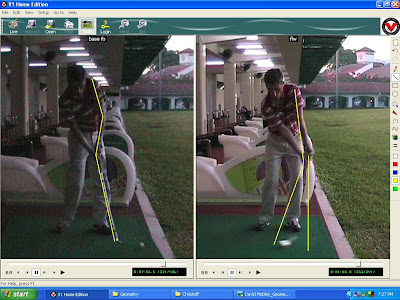
Christophe Starts with the End
With Christophe, we used our "Start with the End" concept to create this INSTANT change in impact alignments.

Under-Shafted...
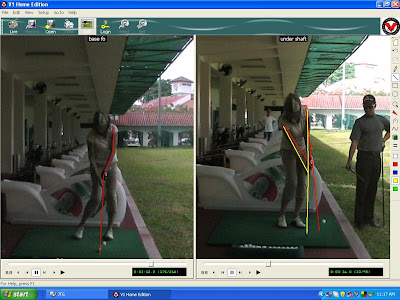
Our "under-shafted" drill helped Anne get her optimum impact alignments back after a long layoff. This drill is part of our "Negative Feedback" and "Mental Imagery" learning concept that is taking the local golf scene by storm and giving golfers hope that they too can play the best golf of their lives CONSISTENTLY.

Tuesday, July 10, 2007
Congratulations - HSBC Golf Challenge 2007 Champion

Justin Tang Golf wishes to extend a hearty congratulation to one of its students, Lim Chee Chein.
The 51 year young systems engineer who plays off 12.2 bested a stellar field at the HSBC Golf Challenge 2007 with a gross score of 3-over par 75 under the Stableford Individual Double Perioa system.
Said the champion: "I blew my first hole when I drove into the trees on the right and three-putted for a triple bogey, I thought it was all over."
Besides winning an all-expenses-paid trip for two to watch golfing superstars such as Vijay Singh, Sergio Garcia et al at the HSBC Champions Tournament in Shanghai from 8 to 11 Nov, he also wins a special lesson package from Justin Tang Golf.
In the run-up to his victory, Lim had been working on his impact alignments and the plane of his swing. His success proves that age is not a barrier in a sport where it is widely held that age is a hurdle.
Next on his list of improvements to make is his putting despite having 5 birdies in a round where his putter "caught fire". It is this dedication to improvement that duly netted Lim the title of HSBC Golf Challenge Champion 2007.
Monday, July 9, 2007
How Long Does It Take You To Learn How To Kick A Ball?
As you may have noticed, we took a well deserved break from golf instruction for about 7 days.
In this period of time, we learnt some GROUND BREAKING instructional stuff that produced the following swing in 2 sessions.
Yes, I can hear the sarcasm, disbelief etc..."No, you made that up," "That can't be true, golf is too difficult."
If that is what you are saying, then
1) I don't have the time to make up these stories and neither am I the lying sort.
2) You will always get what you say, so if you are saying that golf is difficult then it will always be difficult. Think about it, how difficult can the game be if the ball is not moving??
3) The student is not 'smart' enough to reason with me about the golf swing etc...hey, the kid does not even know who the heck Ernie Els is nor read a golf magazine in his life.
4) It takes a heck lot of talent to produce such dramatic results in 2 sessions and of course the simplicity of The Golfing Machine.
5) To find out what technology was used to create such mind blowing results, call or email me. Afterall, how long did it take you to learn how to kick a ball?
In this period of time, we learnt some GROUND BREAKING instructional stuff that produced the following swing in 2 sessions.
Yes, I can hear the sarcasm, disbelief etc..."No, you made that up," "That can't be true, golf is too difficult."
If that is what you are saying, then
1) I don't have the time to make up these stories and neither am I the lying sort.
2) You will always get what you say, so if you are saying that golf is difficult then it will always be difficult. Think about it, how difficult can the game be if the ball is not moving??
3) The student is not 'smart' enough to reason with me about the golf swing etc...hey, the kid does not even know who the heck Ernie Els is nor read a golf magazine in his life.
4) It takes a heck lot of talent to produce such dramatic results in 2 sessions and of course the simplicity of The Golfing Machine.
5) To find out what technology was used to create such mind blowing results, call or email me. Afterall, how long did it take you to learn how to kick a ball?